 DAN RUO IVF CLINIC
PGT refers to genetic testing of embryos. Different types address different questions, so the exact test and reason for testing matter.
BEFORE AN IVF CYCLE
A testing plan, a laboratory contact and a clear quote.
For a PGT enquiry at DRC, ask the team to confirm the proposed test, who performs the genetic analysis, the expected reporting process and the full cost before treatment starts.
Request a PGT planning consultationOpens WhatsApp. Ask how to share genetic reports securely; do not send family medical documents in the initial enquiry.
Who coordinates the clinic and laboratory?
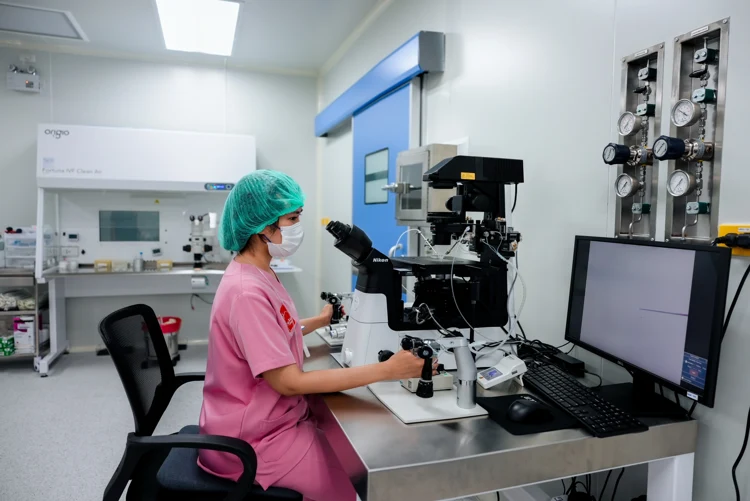
DRC’s published team profile lists Nawaporn Duangprapat as Embryology Lab Director. That role does not by itself identify the laboratory performing a particular genetic test.
For your case, ask DRC to name the treating clinician, embryology contact, receiving genetic laboratory and professional who will explain the report. Confirm where biopsy and analysis take place, how samples and embryo identifiers are matched, and whether a genetics appointment or family-specific test preparation is needed. The receiving laboratory and turnaround are not confirmed on this page.
Your appointment and report-review checklist
- Book the initial review. Tell DRC whether your question concerns chromosome screening, an inherited condition or a chromosome rearrangement. Ask what reports are needed and how to send them securely.
- Confirm feasibility before the cycle. Ask which test and method the laboratory proposes, whether family samples or preparation are required, and when the laboratory can accept the case.
- Agree the treatment and testing scope. Get the sampling, testing, freezing, storage and transfer stages itemised. Confirm expected reporting time and the plan if a sample cannot be tested.
- Arrange the result discussion. Request a copy of the laboratory report and an appointment to discuss the findings, limitations, any uncertain or mosaic result and available next steps before deciding about transfer.
Ask who will answer follow-up questions, whether genetics review carries a separate fee, and how any need for prenatal testing would be discussed. A report is not a guarantee of pregnancy or a child without health problems.
What should an itemised PGT quote show?
| Cost component | Confirm with DRC |
|---|---|
| IVF/ICSI cycle | Consultation, tests, stimulation, retrieval, anaesthesia and embryo culture; medication and other exclusions. |
| Biopsy & sample handling | Biopsy fee, handling/courier charges, sample limits and any repeat-biopsy charges. |
| Genetic testing | The exact test, included embryo count, additional-embryo fee and whether PGT-M/PGT-SR or family-specific preparation is quoted separately. |
| Freezing, storage & transfer | Included storage period, renewal fees and whether a later frozen-embryo transfer is included or separate. |
| Counselling & report review | Who provides interpretation, appointment fees and costs if results are inconclusive or further testing is considered. |
DRC’s supplied ICSI-with-PGT material distinguishes cycle/laboratory work, screening and storage, with additional testing categories. The current test scope, payable amounts, laboratory and timing require a written case-specific confirmation—not an assumed package inclusion.
What is PGT-A?
PGT-A assesses chromosome number in embryo cells. It does not test for every genetic condition. It has not been shown to improve the chance of a baby for most IVF patients, although it may reduce miscarriage risk in some circumstances. It is not a routine requirement for everyone having IVF, and a discussion should distinguish outcomes per transfer from the chance of a baby across an entire cycle.
What is PGT-M?
PGT-M looks for a specific inherited single-gene condition. A known genetic finding, such as a familial thalassaemia variant, may prompt a genetics consultation. The laboratory must assess whether a suitable test can be developed for the family.
What is PGT-SR?
PGT-SR is used when a parent has a structural chromosome rearrangement, such as a balanced translocation. It looks for unbalanced chromosome material in embryos. Ask whether the proposed method distinguishes a carrier embryo from one without the rearrangement.
How does the testing journey work?
Begin with a review of genetic reports and family history. If testing is appropriate, clarify the laboratory requirements before starting IVF. Embryo sampling, testing and the later transfer decision are separate steps; confirm the expected timing and costs with your team.
What do the results mean?
Results need interpretation in context. Ask how the laboratory reports uncertain or mosaic findings, and what options exist if no embryo is considered suitable for transfer. Testing cannot guarantee pregnancy or a child without health problems.
What should we discuss before deciding?
Ask about test accuracy, the possibility of an inconclusive result, embryo biopsy risks and alternatives. Discuss whether prenatal testing would still be advised after pregnancy. Genetic counselling can help connect the result to your family’s choices.